Tuesday, February 26, 2013

Water Stuff

Homework Handout (from class):  About Osmosis, the way water travels across a semi-permeable membrane from an area of high concentration to an area of lower concentration.   Try to remember enough from class to figure it out, but we will be going over it on Thursday in class, so you don't need to fill in what you don't know.

Water is so important to life!

Here's another experiment to do at home (easy set-up, but observe throughout the day.) Draw or take pictures  or describe with words, and be sure to record the time in your lab notebooks.

The directions:
Materials:
  • two clear plastic cups
  • water
  • food coloring
  • one sheet of paper towel
  • a large, thick book
  • an undisturbed area of the classroom
Procedure:  Start this experiment in the morning. Place two clear cups approximately 1-2 inches apart. Fill one cup about 3/4 full and drop in some food coloring. Roll a sheet of paper towel and flatten it to a long 1-inch flat rectangle. Place the paper towel across the cups, touching the water in the first cup, and placed into the second cup.  Make a prediction about what may happen--the hypothesis.
  1. Set up a chart after your hypothesis. It should include two columns: Time and Observations.
  2.  In one hour you should observe what will happen.
  3.   Next,  you will be placing a large, thick book under one of the cups (Place it under cup 2, the cup that did not initially have water in it, so that you see that water moves in ____________).  Predict what will happen.
  4. Place the book and watch what happens! After a period of time, the water levels will be at the ____ height within each cup.
  5. Think about why the water travels the way it does. Cohesion is the ability for water to attach to itself and travel. Adhesion is the ability for water to attach to other materials. 

Your lab "report" should be this:
Title
Briefly, what I am going to do (describe the experiment)
What I think will happen (the hypothesis)
What is happening (drawings and descriptions, with the time given ...after one hour...after two hours...etc.
Why I think it happened that way.

Friday, February 8, 2013

The Big O--Osmosis

First to review Thursday's Cell Membrane - the BuBBle Model:  Write in your lab notebooks what your remember from lab. 25 pts.
1. How did you demonstrate the FLUIDITY and the FLEXIBILITY of the membrane?
2. How did you show how a large item could pass through? (more than one way)
3. How did you show the membrane bound organelles inside the cell?
4. How did you show binary fission - when the cell divided?
[This should be a paragraph of at least 6-8 sentences.)
 

THE EGG-SPIRIMENT...
Last Monday's homework was to sit 3-4 chicken eggs in vinegar so that their shells would dissolve, leaving you with a "naked cell"--no shell but held together with a membrane.
When that is done, it is time for Step Two:  OSMOSIS-- a big word in biology.  It means the passage of water through the membrane, but which way will it go?  Will the water in the egg leave the egg and go into the solution, or will the water in the solution  go through the membrane and into the egg?   We will experiment.

This is what you did to make the "naked eggs." --http://www.exploratorium.edu/cooking/eggs/activity-naked.html

And here are the directions for what to do next:  http://www.exploratorium.edu/cooking/eggs/activity-nakedexperiment.html

BUT READ THIS FIRST:  I had you soak 3-4 eggs because sometimes one breaks, but also so that you can try soaking the third egg in something besides water or corn syrup.  That extra egg or two, could you think of another  liquid to try?  It could be something in your kitchen or in your cleaning supply, but make sure you ask your mom first, nothing toxic, please.  Also, use gloves where appropriate and observe safety precautions.  Call me if you have a question. [no corn syrup? substitute pancake syrup or super-concentrated sugar water.]

IN YOUR LAB Books, record your observations and either draw accurately or take photos and paste in and label.  Then in paragraph form, explain what happened.  ("The egg which was in water grew/shrank/turned purple/whatever..."  50 pts.

Lastly, some Brainpop, which you can do next Tuesday or Wednesday, if you wish.  Movie, quiz, worksheet, FYI-- 15 pts. each        [pcshome/ilearnathome]
Did I say lastly? oops.  Short quiz on vocabulary next Thursday, so review the quizlet and be able to draw and label the prokaryotic cell, and the plant and animal cell.

THIS IS HOMEWORK FOR A WHOLE WEEK, AND DUE ON THURSDAY, BUT YOU MUST NOT PUT OFF THE FIRST AND SECOND PARTS -  first, review the bubble lab and answer the questions in your lab books. Second, get the eggs-piriment started since it will take a few days of watching.  You have time to do it over if it gets messed up, but not time to put it off till the last minute.  http://quizlet.com/19171567/7th-grade-cells-multicellular-organisms-holt-flash-cards/


Thanks for a fun class; I really enjoyed it and appreciated that you were involved without getting too crazy.   I hope you feel like I do, how great and amazing is God's wisdom in creating something so small yet so intricate, which is able to to perform so many complex functions and to work together so elegantly... 
Bless the LORD, O my soul, and every cell that is within me! bless His holy name.

Tuesday, February 5, 2013

Techno-Crash in Class!

I had planned on Monday to show a video in the sanctuary on the big screen...but that did not happen. (The internet at the church is unreliable :( sorry.  --But we got in a good review.

I would, however,  like you to watch it on your own and take notes as I instructed in class on the back of the handout which had the 4 organisms.  On the back of the handout we wrote down questions to ask, such as, how does it:
  • move, 
  • feed, 
  • reproduce,
  • protect itself, 
  • and anything else?

Getting to the video is more tricky than usual, so follow these directions:
Go to ebiomedia.com 
In the top left corner choose "click here to sign in"
login as  Veronique
password is jimbridger
On the upper right corner, choose "my account"
then choose "My Videos"
then beneath  Paramecium, Hydra, Planaria, Daphnia choose "+show video links"
lastly, next to 1. Watch full program, choose "watch video"
This is a 30 minute video.
It is likely that only one computer can log into my account at a time, so if it doesn't work when you try, possibly someone else is watching, so try back later.  If you have problems, call me at 892-8540. 25 points for taking notes on the back of the handout.  If you lost your handout, you may find it on this site here:  http://www.ebiomedia.com/media/POSTERS/POSTER-CLASSICS.pdf

Class on Thursday will be about the Cell Membrane and the Big O in Biology.  To prepare, please cover 3-4 uncooked  eggs in white vinegar (or cider vinegar, not expensive balsamic!)  This is to remove the shell layer.  Observe; do not bring to class.  This experiment you will do at home over the next week. This is only the  beginning--More instructions to follow on Thursday.

Read Chapter 2, section 1 - Exchange with the Environment  Answer questions. 25 pts.

Checklist:
1. watch movie + take notes
2. submerge 3-4 eggs in vinegar
3. read ch.2, sec. 1 + answer review questions.
4. review vocabulary through quizlet. (see last week's homework)

Thursday, January 31, 2013

Multi-Cellular Spectabuliciousness


  https://encrypted-tbn2.gstatic.com/images?q=tbn:ANd9GcSO9-pDWXx-_-cIq_ykCnYTxleBpuQagBPSHnPBCLM0MTMJO202

Paramecium...single cell
Hydra ...two layers of cells (tissues)
Planaria...three layers
Daphnia...organs
Structure, behavior, feeding, reproduction, and ecology
They do it all. 

Next Monday we will continue our study.

Homework for Friday: Read chapter 1, Section 3: The Organization of Living Things, plus answer questions in section review (page 23) and chapter review (pages 26-27)   50 pts. for complete answers.

Also, in preparation for next week's quiz, here is the quizlet: http://quizlet.com/19171567/7th-grade-cells-multicellular-organisms-holt-flash-cards/


Monday, January 28, 2013

Don't Be Cell-fish ...


Fish Cells, colorized


Read Textbook Chapter  1, section 2.  Use that information to fill out the worksheet handed out in class.  50 points for a job carefully done.


Some videos:
Inner Life of the Cell: What we watched in class, now watch to see what structures you can recognize, and what you think is happening.  Bear in mind the white rolling cell is a white blood cell, whose job is to find and destroy the germ-invaders.

Review of class/ Cell Structures
http://www.youtube.com/watch?v=2s87SyRh3t0&list=PLF34A8BA3412E7D64  5 pts.

BrainPOP  login: pcshome  ilearnathome
http://www.brainpop.com/science/cellularlifeandgenetics/cellstructures/
movie, quiz, activity page (5 pts. each page) and FYI - 20 points for all


Friday, January 25, 2013

Cell-ery


Remember the Cell Theory:
Cells are t-- b---- u---- o- l---.
All l------ t----- a-- m--- o- c----.
All cells c--- f--- p--e-------- c----.

Remember the parts of the prokariotic cell (bacteria):
cell w---, cell m-------, c--------, D--, r-------, f---------, p---, p------.


Today in class:
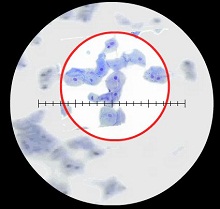
What kind of cells did we look at under the microscope?
1. bacteria (yogurt)
4. protist (single-celled animal)
cells at 10x
human cheek cell

Anacharis 400x
2. anacharis (little plant leaf)
yeast cells dividing


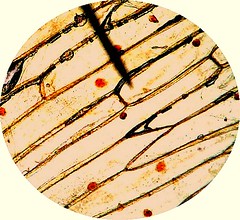
Onion 100x
3. onion skin
In these photos, can you find:
-cell wall or membrane
-nucleus
-cytoplasm
-any organelles

On Monday we will look at these again, but not under microscopes.  btw, good job *focusing* in class. ;)  -pun intended.


HOMEWORK:
  1. plant cell coloring page 15 pts.
  2. Review reading: chapter 1, section 1. pages 2-11  just reading if you have already done the study guide questions, if not, do so now.  10 pts.
  3. Observing the shrimpies: If they still live, describe.  If not, hypothesize why they may have died. Be sure to describe the environmental conditions: water-is it clear or cloudy? How warm is the water? and anything else that you think might be important.  Write in your science journal.  10 pts.

Optional Video:
Brainpop.com http://www.brainpop.com/science/cellularlifeandgenetics/cells/  password: pcshome   username: ilearnathome  --movie, quiz, FYI, activities (first worksheet only) 15 pts.
http://www.brainpop.com/science/cellularlifeandgenetics/cellspecialization/  --movie, quiz, FYI, activity (one page-vocabulary) 15 pts.

Monday, January 21, 2013

Micrographia

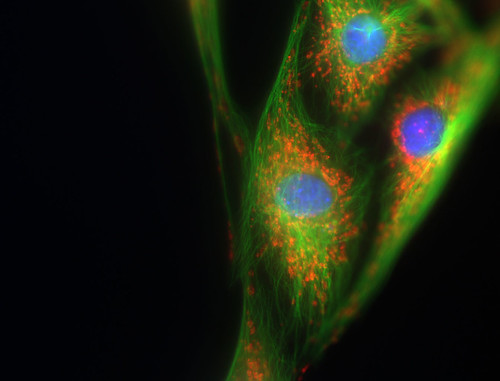
When Robert Hooke wrote Micrographia back in 1665, it was an incredible work of art as well as an enlightening book of science. Today that tradition of combining art and science continues through some amazing photography.  Below is a collection of cells arranged into a Christmas collage; the organelles are stained various colors.  These are some of the many types of cells found in a mammal's body, magnified between 200-2000x. Each of these cells has a specific function; some might be blood cells or muscle cells or skin cells or ...the list goes on....

Your assignment is to produce a mini-book showcasing the various specialized cells, which could include bacterial cells, archaea cells, single-celled animals, and the various types of cells found in plants or animals.  You choose.  Draw accurately and label what type of cell it is and where it would be found.  Cover + six cells = 35 pts.   How to find images: When you use Google image search it it ABSOLUTELY ESSENTIAL to make sure the safe search is ON. Look in the upper right corner. Please get your mom to start you off. I suggest you search for "cells photography microscopic." Not all the pictures will be what you are looking for.

Next, the two coloring pages given in class: I suggest using colored pencils or fine point markers.  You are asked to read the back page until you come to an instruction to color.  First you color the "item" and then you use the same color to write over the word label at the top of the page. Then color the sentences on the written side which are the description with that same color. 15 pts.

If you have extra time and wish to have less homework on Friday, you may read Chapter 1, section 2 and answer the study guide questions.

If your swimmies are still alive, great job!  Can you please bring them to class on Thursday so we can view them under a microscope?

Thanks for class today, and for the "lively" [*pun*] debate. As George Washington once said, "The mind of a jr. higher is a scary place to be."

He didn't really say that.
liverwort (20X)