Thursday, March 14, 2013

My Toes Itch

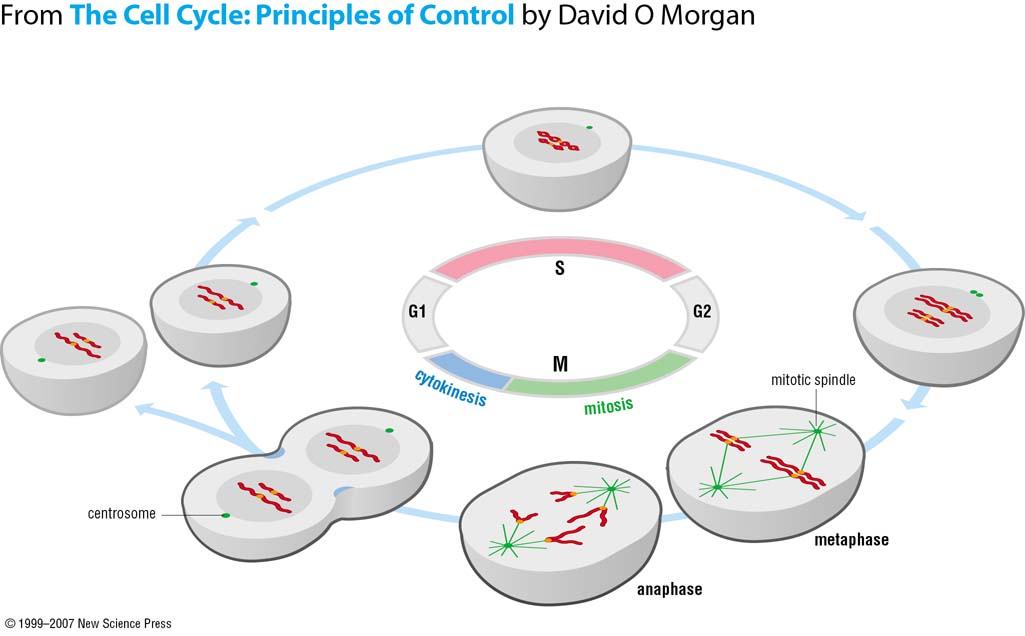
Review: When your body needs new cells, it generates them by MITOSIS!  which is basically sorting the DNA/chromosomes into two sets and then dividing them up so that now there are two cells instead of one.  The new cell contains an IDENTICAL copy of chromosomes.  Each cell in your body, although there are many different kinds, has your own unique DNA -- it is like a genetic fingerprint -- and unless you are an identical twin, no one else has DNA like you do.  That makes you special.

CELLS ALIVE! mitosis Interactive [click to go to site]for fast, click "play" and then slow it down by clicking "step" -- Repeat many times until you've truly understood.

The Cell Cycle has 3 major stages:  Interphase, MITOSIS! and Cytokinesis, and Mitosis has 4 steps.
Here is a way to remember the steps of MITOSIS!
-> Paul Met Anna Twice.--PMAT
Prophase >Metaphase >Anaphase >Telophase


HOMEWORK:  Finish the MITOSIS! flip book, using your textbook or this page, if you wish.  If you need a new copy, go here: MITOSIS! flip book template. 
On the blank pages of the flipbook, write what is happening on that page. -- does this make sense to you?  You should be able to flip the book to see the action, and also to read it like a book with the words on the left hand page and the illustration on the right hand page. Your textbook will help.  If you are not sure what I mean, call me.

And here are some fun videos to watch, made by students:


Monday, March 11, 2013

First, a review of class:
First we demonstrated that breathing out produced CO2 gas. How? by blowing through a straw into a solution of water and bromothymol blue.  Here is another way of doing that:


Then we did the famous elodea in a test tube under lights, and observed the oxygen bubbles that were produced.  It looked like this:

As much fun as watching the grass grow.  But with friends and a sunny day, not bad at all.

Hopefully you looked again at the plants after a few hours.  The elodea under the super-bright light got kinda fried, which of course diminished its ability to photosynthesize!  The plants under the cooler overhead projector lights were cooler and still going strong, as were the sprigs in the sun, (I think those were the most efficient.)  The plants which only received indirect light did not bubble very much; less O2 means less photosynthesis.

Doing these two experiments together illustrated the connection between photosynthesis and cellular respiration.

Watch this video to summarize what we have learned about photosynthesis and cellular respiration:


**********************************************************************
Next subject: Mitosis: how cells replicate themselves
Prepare by reading Chapter 2: section 3  and answering the questions.
You may also wish to watch the brainpop: http://www.brainpop.com/science/cellularlifeandgenetics/mitosis/
  [pcshome / ilearnathome ]

Thursday, March 7, 2013

Transpiration Inspiration - Another Great Celery Experiment

IMPORTANT: Run and tell your mom you will need celery for this experiment.  Promise her that in return for (maybe) running to the store to buy the needed item, you will eat your vegetables, cheerfully, for a week.

What is the role of leaves in transpiration?25 points
Materials: 3 stalks of celery with leaves, glass or jar, red or blue food coloring,  petroleum jelly (Vaseline), knife, metric ruler.

Procedure:
1. Cut 1 cm off the bottom of three celery stalks. (Caution: use knife with care!)
2. Remove leaves from one stalk.  Apply petroleum jelly (Vaseline) on both sides of the leaves of another stalk.  Leave the third stalk alone; it is the control.
3. Place all three stalks in a container containing 5 cm of water and food coloring.
4. Place the beaker in a sunny location. Observe the celery periodically for 24-36 hours.  Record your observations, and perhaps take a photograph.

Analyze and Conclude:
1. Observations: In which stalk did the colored water rise the most?  The least?
2. Inferring: What effect did the petroleum jelly have on transpiration?  What part of the leaf did the petroleum jelly affect?
3. Drawing Conclusions:  How are leaves involved in transpiration?


If you did not complete your homework last week, do so now.  That means read Chapter 2, section 2 and carefully and artistically copy diagram 3 in colored pencils; that's right, the entire diagram on page 40.
 25 points

As an alternative, you may do Brainpop.com [ pcshome / ilearnathome ]  25 points
http://www.brainpop.com/science/cellularlifeandgenetics/photosynthesis/   ////watch movie, fill out vocabulary sheet (activity) and take quiz
http://www.brainpop.com/science/cellularlifeandgenetics/cellularrespiration/  ///same - movie, vocabulary and quiz.

Tuesday, March 5, 2013

Powerful Wet Stuff

Thanks for a fun class yesterday.  To remind you, we discussed the all-important water molecule, so essential for life.  The properties of water included its polarity, cohesion, adhesion and surface tension.  Can you answer these questions in your lab notebook? (copy the question and answer it.)


1.  Write the chemical equation for water.
 
2. Draw a Stick model of a water molecule
  

3. Sketch a group of water molecules, showing where they stick together.


4. How is a water molecule like a magnet?
 
5. What causes surface tension in water?  
 
6. Give an example that you observed of surface tension.
 
7. Define cohesion in your own words.  Give an example.

8. Define Adhesion in your own words. Give an Example.


9.  How might these properties explain how a plant pulls water out of the soil and up to its leaves?  Describe what you think happens.


Next Subject in Science:    Read Chapter two, section 2 (pages 38-41) in your textbooks 
 Cell Energy -- photosynthesis and cellular respiration.
Copy Figure 3 into your lab notebook.

Finally, start collecting 2-liter pop bottles, preferably clear.  Each student will need 5!  Youth groups and other meetings might be a good place for this. 


Friday, March 1, 2013

onion cells & other stuff

 A tale of two experiments...

First, the onion skins, which we looked at under microscopes in class; you peeled a fine layer of cells and mounted it on the slide.  You drew a picture of one or more of the cells with the purple cytoplasm and the cell wall, maybe a nucleus.  Then you added a drop of salt water and observed.  It should have looked like this, before and after:


In your lab notebooks, write up your experiment neatly. Title, description of  procedure, hypothesis (what do you think will happen?) drawings or photos, describe what happened, explain what happened.  In your explanation use the words from your worksheet: osmosis, greater/lesser concentration of water, hypotonic, hypertonic.  Label your drawings or photos with  cell wall, membrane, cytoplasm, nucleus.
(25 points)


Next, the Home Experiment:  Did it look like this?  I started with two glasses, one was 3/4s full and one was empty.  It took way longer that the directions implied; in fact, it took 24 hours to reach the point where the water levels were equal.  Now I am going to put one of the glasses on top of a book and see how that changes things.

Write this up in your lab books, if you have not already done so: Title, description of  procedure, hypothesis (what do you think will happen?), drawings or photos, describe what happened, explain what happened.


Tuesday, February 26, 2013

Water Stuff

Homework Handout (from class):  About Osmosis, the way water travels across a semi-permeable membrane from an area of high concentration to an area of lower concentration.   Try to remember enough from class to figure it out, but we will be going over it on Thursday in class, so you don't need to fill in what you don't know.

Water is so important to life!

Here's another experiment to do at home (easy set-up, but observe throughout the day.) Draw or take pictures  or describe with words, and be sure to record the time in your lab notebooks.

The directions:
Materials:
  • two clear plastic cups
  • water
  • food coloring
  • one sheet of paper towel
  • a large, thick book
  • an undisturbed area of the classroom
Procedure:  Start this experiment in the morning. Place two clear cups approximately 1-2 inches apart. Fill one cup about 3/4 full and drop in some food coloring. Roll a sheet of paper towel and flatten it to a long 1-inch flat rectangle. Place the paper towel across the cups, touching the water in the first cup, and placed into the second cup.  Make a prediction about what may happen--the hypothesis.
  1. Set up a chart after your hypothesis. It should include two columns: Time and Observations.
  2.  In one hour you should observe what will happen.
  3.   Next,  you will be placing a large, thick book under one of the cups (Place it under cup 2, the cup that did not initially have water in it, so that you see that water moves in ____________).  Predict what will happen.
  4. Place the book and watch what happens! After a period of time, the water levels will be at the ____ height within each cup.
  5. Think about why the water travels the way it does. Cohesion is the ability for water to attach to itself and travel. Adhesion is the ability for water to attach to other materials. 

Your lab "report" should be this:
Title
Briefly, what I am going to do (describe the experiment)
What I think will happen (the hypothesis)
What is happening (drawings and descriptions, with the time given ...after one hour...after two hours...etc.
Why I think it happened that way.

Friday, February 8, 2013

The Big O--Osmosis

First to review Thursday's Cell Membrane - the BuBBle Model:  Write in your lab notebooks what your remember from lab. 25 pts.
1. How did you demonstrate the FLUIDITY and the FLEXIBILITY of the membrane?
2. How did you show how a large item could pass through? (more than one way)
3. How did you show the membrane bound organelles inside the cell?
4. How did you show binary fission - when the cell divided?
[This should be a paragraph of at least 6-8 sentences.)
 

THE EGG-SPIRIMENT...
Last Monday's homework was to sit 3-4 chicken eggs in vinegar so that their shells would dissolve, leaving you with a "naked cell"--no shell but held together with a membrane.
When that is done, it is time for Step Two:  OSMOSIS-- a big word in biology.  It means the passage of water through the membrane, but which way will it go?  Will the water in the egg leave the egg and go into the solution, or will the water in the solution  go through the membrane and into the egg?   We will experiment.

This is what you did to make the "naked eggs." --http://www.exploratorium.edu/cooking/eggs/activity-naked.html

And here are the directions for what to do next:  http://www.exploratorium.edu/cooking/eggs/activity-nakedexperiment.html

BUT READ THIS FIRST:  I had you soak 3-4 eggs because sometimes one breaks, but also so that you can try soaking the third egg in something besides water or corn syrup.  That extra egg or two, could you think of another  liquid to try?  It could be something in your kitchen or in your cleaning supply, but make sure you ask your mom first, nothing toxic, please.  Also, use gloves where appropriate and observe safety precautions.  Call me if you have a question. [no corn syrup? substitute pancake syrup or super-concentrated sugar water.]

IN YOUR LAB Books, record your observations and either draw accurately or take photos and paste in and label.  Then in paragraph form, explain what happened.  ("The egg which was in water grew/shrank/turned purple/whatever..."  50 pts.

Lastly, some Brainpop, which you can do next Tuesday or Wednesday, if you wish.  Movie, quiz, worksheet, FYI-- 15 pts. each        [pcshome/ilearnathome]
Did I say lastly? oops.  Short quiz on vocabulary next Thursday, so review the quizlet and be able to draw and label the prokaryotic cell, and the plant and animal cell.

THIS IS HOMEWORK FOR A WHOLE WEEK, AND DUE ON THURSDAY, BUT YOU MUST NOT PUT OFF THE FIRST AND SECOND PARTS -  first, review the bubble lab and answer the questions in your lab books. Second, get the eggs-piriment started since it will take a few days of watching.  You have time to do it over if it gets messed up, but not time to put it off till the last minute.  http://quizlet.com/19171567/7th-grade-cells-multicellular-organisms-holt-flash-cards/


Thanks for a fun class; I really enjoyed it and appreciated that you were involved without getting too crazy.   I hope you feel like I do, how great and amazing is God's wisdom in creating something so small yet so intricate, which is able to to perform so many complex functions and to work together so elegantly... 
Bless the LORD, O my soul, and every cell that is within me! bless His holy name.